
What’s Required to Work With a Nursing Agency?
Jul 25 , 2026
Call us 24/7 on
1300 10 50 10Follow us:


Call us 24/7 on
1300 10 50 10Follow us:
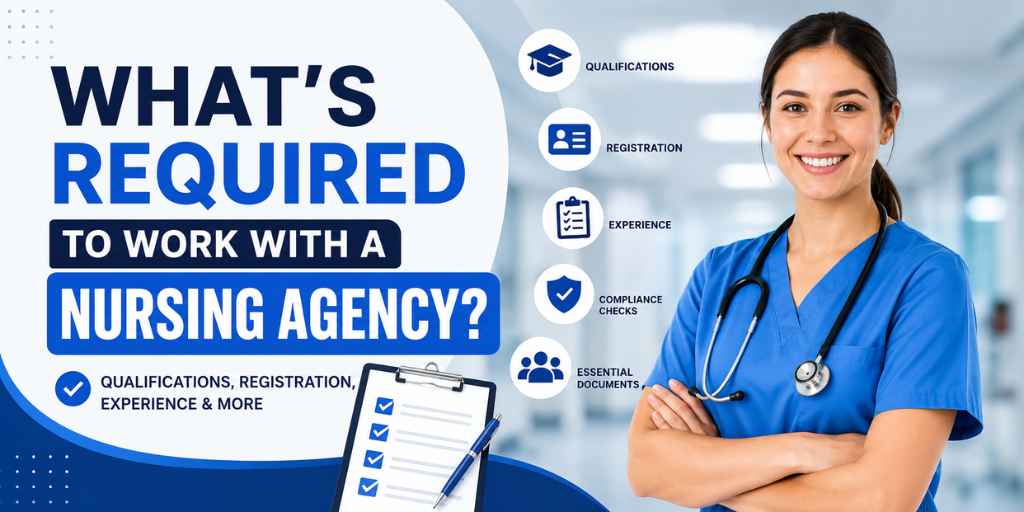
Working with a nursing agency is an excellent way to enjoy greater flexibility, competitive pay, and diverse career opportunities. Whether you’re an experienced registered nurse (RN), enrolled nurse (EN), or assistant in nursing (AIN), agency work allows you to choose shifts that fit your lifestyle while gaining experience across hospitals, aged care facilities, and community healthcare settings.
If you’re considering agency nursing, you may be wondering, “What’s required to work with a nursing agency?” While the exact requirements vary between agencies, most follow similar standards to ensure healthcare professionals are qualified, compliant, and ready to provide safe patient care.
Here’s everything you need to know before applying.
The first requirement for working with a nursing agency is having a recognised nursing qualification.
Depending on your role, this may include:
Your qualifications should be recognised in Australia if you intend to work in Australian healthcare facilities.
If you’re working as a Registered Nurse or Enrolled Nurse in Australia, you must hold current registration with the Australian Health Practitioner Regulation Agency (AHPRA).
Your registration confirms that you:
Most nursing agencies will verify your registration before offering shifts.
Many nursing agencies require previous clinical experience before placing candidates.
Typical requirements include:
Some agencies also recruit newly graduated nurses, although opportunities may be more limited.
Healthcare providers have a legal responsibility to ensure staff meet workplace safety and compliance standards.
You may be asked to provide:
Keeping these documents current helps speed up the onboarding process.
Many healthcare facilities require additional certifications depending on the role.
These commonly include:
Specialist nursing positions may require additional certifications relevant to intensive care, emergency nursing, theatre, or mental health.
Technical skills alone are not enough to succeed as an agency nurse.
You’ll regularly work with new teams, patients, and healthcare professionals, making communication essential.
Successful agency nurses are able to:
Good communication improves patient safety and helps you integrate into unfamiliar workplaces.
One of the biggest advantages of agency nursing is flexibility, but it also requires flexibility from you.
Agency nurses often work in different:
Each workplace has its own systems, policies, and procedures. Being adaptable allows you to settle into new environments quickly and provide quality patient care from your first shift.
Most nursing agencies request two or more professional referees who can confirm your:
Recent supervisors or nurse unit managers are usually preferred as referees.
Having your documents organised before applying can significantly speed up your registration with a nursing agency.
Typical documents include:
Many agencies now allow these documents to be uploaded through an online portal.
Once you’ve met the requirements, agency nursing offers many career benefits.
These include:
Choosing a reputable nursing agency is just as important as meeting the eligibility requirements. A trusted agency will guide you through the registration process, help you complete compliance checks, and match you with roles that align with your skills, experience, and career goals.
Whether you’re seeking casual shifts, contract placements, or long-term opportunities, working with an experienced agency can make the transition into agency nursing smooth and rewarding.
Working with a nursing agency is an excellent way to build a flexible and fulfilling nursing career. By obtaining the necessary qualifications, maintaining AHPRA registration, completing compliance checks, and keeping your certifications up to date, you’ll be well prepared to access a wide range of nursing opportunities across Australia.
If you’re ready to take the next step, partnering with a professional nursing agency can connect you with rewarding roles in hospitals, aged care, community health, and regional healthcare facilities, helping you grow your career while enjoying the flexibility that agency nursing offers.

Follow us: